
- Home
- Care & problems
- Drainage field failure
Is your drainage field failing? Signs, causes and costs
The tank gets the attention. The drainage field does the real work. When it fails, the garden tells you first.
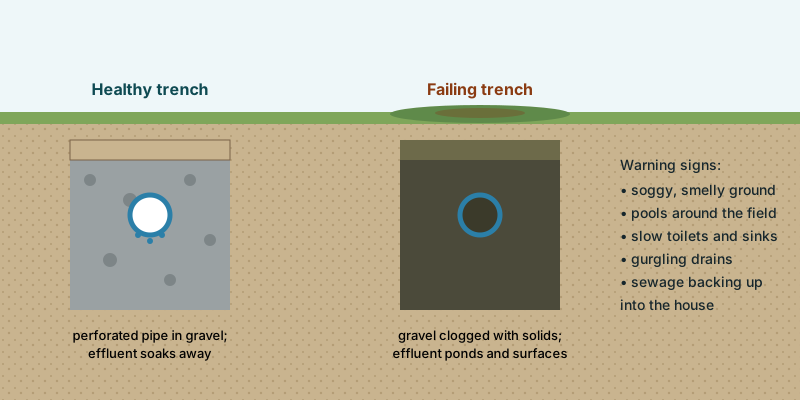
A septic tank only settles solids. The liquid that leaves it is still dirty. The drainage field finishes the job, letting it soak slowly through soil that filters and treats it. When the soil clogs, there’s nowhere for the effluent to go but up or back.
Quick answer
- Main signs
- Soggy ground, smells, slow drains, gurgling, backing up
- Main cause
- Solids carried over from a tank that isn't emptied
- Replacement
- £3,000–£7,000 (Checkatrade); £7k–£15k (Home Septic)
- Typical life
- 20–30 years if well maintained (Checkatrade)
- Legal duty
- Repair or replace a system not in good working order
Costs checked October 2026. Sources disagree, so get quotes.
The warning signs
Checkatrade lists four signs of a failing field:
- sewage smells in the house or garden
- soggy or swampy ground over the field, even in dry weather
- slow drains or gurgling
- sewage backing up into the house
Gov.uk’s list of problems that mean your system must be repaired includes “pools of water around the drainage point” and sewage smells.
If problems get worse after heavy rain, the ground may be saturated or rainwater may be getting into the system.
Why drainage fields fail
Solids carry-over. The big one. Approved Document H says that if the tank isn’t maintained and solids get into the field, “the sediments can block the pores in the soil, necessitating the early replacement” of the field. Gov.uk says the same: skipping desludging can cause “damage and pollution, leading to potentially expensive and disruptive repairs”.
Too much water. Rainwater from gutters or drives, or more people than the system was designed for, can overload it.
Wrong design or wrong ground. Approved Document H says a field should only be used where percolation tests give an average Vp between 12 and 100. Clay often fails that.
Damage. Approved Document H says no access roads, driveways or paved areas should be in the disposal area. Vehicles and roots crush and block pipes.
Old age. Checkatrade says a well-maintained field typically lasts 20 to 30 years.
What to do
- Book an empty if it’s overdue. It buys time, but won’t fix a clogged field.
- Cut the water going in. Divert rainwater away. Spread out washing loads.
- Get it inspected. Checkatrade says a specialist may recommend a CCTV drain survey or a septic tank inspection.
- Decide: repair or replace. A blocked or damaged pipe section can cost less. A clogged field usually means a new one.
Replacement costs
Sources don’t agree, so treat these as a range, not a price.
| Source | Drainage field | Tank and field |
|---|---|---|
| Checkatrade (October 2026) | £3,000–£7,000, average about £5,000 | — |
| Home Septic (specialist firm) | about £7,000–£15,000 | about £14,000–£25,000 |
Checkatrade says the percolation test, site survey, emptying the old tank, removing spoil, landscaping and Building Control sign-off are often priced separately.
Need a price for your property? Our quote service is coming soon. Until then, use the local firms directory and ask at least three for a written quote.
Get quotesThe rules for a new field
In England a new drainage field needs Building Regulations approval and must meet the general binding rules, including the British Standard for drainage fields, currently BS 6297:2007. Approved Document H sets the distances: at least 10 m from any watercourse or permeable drain, 50 m from a water abstraction point and 15 m from any building.
If you move the discharge point more than 10 m, gov.uk treats it as a new discharge. Different rules apply. See our general binding rules guide.
In Wales, Natural Resources Wales says drainage fields must be built to BS 6297:2007+A1:2008.
If the ground just won’t drain
A sewage treatment plant produces cleaner effluent. It can discharge to a flowing watercourse if one is available and the rules allow. A cesspit is the last resort. Compare them in our systems guide.
FAQ: drainage field failure
What are the signs of a failing septic tank drainage field?
Sewage smells in the house or garden, soggy or swampy ground over the field, slow drains or gurgling, and sewage backing up into the house. Gov.uk also lists pools of water around the drainage point as a sign a system needs repair.
Can a failed drainage field be repaired?
Sometimes. A blocked or damaged section of pipe can be cheaper to fix. But Checkatrade says a failed drainage field usually needs replacing rather than repairing. A CCTV survey or inspection can find out which.
How much does it cost to replace a drainage field?
Checkatrade puts a new drainage field at £3,000 to £7,000, averaging about £5,000 (October 2026). Home Septic, a specialist firm, quotes around £7,000 to £15,000, and £14,000 to £25,000 for a new tank and field.
How long does a drainage field last?
Checkatrade says a well-maintained drainage field typically lasts 20 to 30 years. Regular tank emptying is the biggest thing you can do to make it last.
Can I put a new drainage field in the same place?
Not always. Approved Document H warns that solids carried into a field can block the soil and occasionally make the site unsuitable for a future drainage field. A new percolation test will tell you.
Sources
All links checked October 2026.
- GOV.UK: General binding rules, small sewage discharge to the ground
- GOV.UK: Approved Document H, drainage and waste disposal
- Checkatrade: Drainage field cost (updated October 2026)
- Home Septic: Home buyer survey (repair cost examples)
- Natural Resources Wales: Register your septic tank or small sewage treatment plant

We write plain-English guides for UK homes that are not on mains sewers. Every rule links to the regulator. Every price links to where we found it. About us · How we check costs.