
- Home
- Rules & permits
- General binding rules
The septic tank general binding rules, explained
Eleven rules decide whether your septic tank or treatment plant is legal in England without a permit. Here is what each one really asks of you.
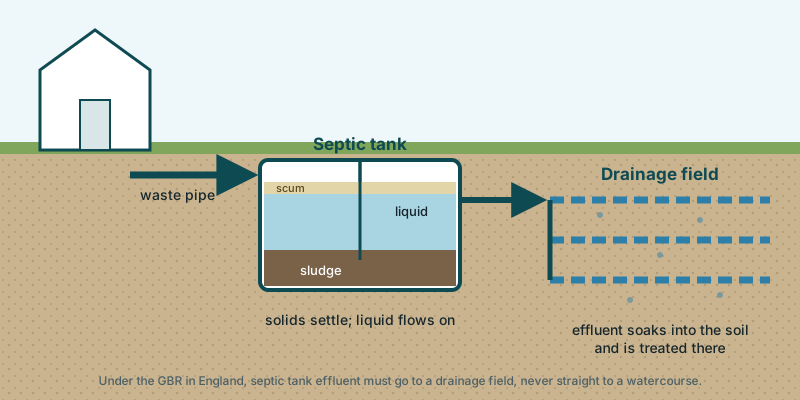
If your home isn’t on mains sewerage, the general binding rules are the law you live under. Meet every rule and you need no permit, no registration and no fee. Miss one and you must fix it, connect to the sewer or apply to the Environment Agency for a permit.
Quick answer
- Applies to
- Septic tanks and small sewage treatment plants in England
- Volume limit
- 2 m³ (2,000 litres) a day to ground; 5 m³ a day to surface water
- Septic tank to a stream?
- Not allowed. Replace, upgrade or connect to sewer
- Emptying
- At least once a year, unless the maker says otherwise
- If you can't comply
- Apply to the Environment Agency for a permit
Scotland (SEPA) and Wales (NRW) have their own systems. See below.
The rules apply in England only. They cover septic tanks and small sewage treatment plants (often called package plants). They don’t cover cesspits.
Who the rules apply to
The rules land on the “operator”. That’s you if you own the property the system serves. If several homes share one system, every owner is jointly responsible. A tenant can be the operator too, if the tenancy agreement says so.
Connected to the mains? Then none of this applies to you.
Ground or surface water: two sets of rules
There are two versions of the rules. Which one you follow depends on where the treated liquid ends up.
| To the ground | To surface water | |
|---|---|---|
| What counts | A drainage field (soakaway) or mound in your land | A river, stream, ditch, estuary, lake, canal or the sea |
| Daily limit | 2 m³ (2,000 litres) | 5 m³ (5,000 litres) |
| Septic tank allowed? | Yes, via a drainage field | No |
| Treatment plant allowed? | Yes, via a drainage field | Yes |
A normal family home produces far less than 2,000 litres a day. The government publishes a calculator for working it out if you’re unsure, for example for a large house or a holiday let.
The rules that matter most
The full rules run to several pages. These are the points that catch people out.
1. Domestic sewage only
Toilets, bathrooms, showers and kitchens. That’s it. Trade waste, or anything that isn’t domestic sewage, needs a permit.
2. A septic tank must go to a drainage field
This is the big one. A septic tank only settles solids. The liquid that leaves it is still dirty and must be treated by soil in a properly built drainage field.
A septic tank must never discharge directly to a watercourse. That includes a field ditch. If yours does, read our guide to septic tanks discharging to a ditch or stream.
3. No pollution
Whatever the paperwork says, your system must not cause pollution. Smells, overflowing chambers or sewage surfacing in the garden all count against you.
4. Built to the right standard
Your tank or plant must meet the relevant British Standard. For prefabricated tanks and plants that’s BS EN 12566. Drainage fields and mounds follow BS 6297:2007. Proof can be a CE mark, a certificate from the maker, or a listing on British Water’s register of approved products.
Systems installed before 1983 don’t need to meet the BS standard. They must still work properly and not pollute.
5. Not too close to sewers, wells or protected sites
- Sewers. For systems installed since 1 January 2015, you can’t use one if a public sewer is within 30 metres of your boundary. For developments, multiply 30 metres by the number of homes.
- Drinking water. You need a permit if your drainage field is in a groundwater Source Protection Zone 1. That includes being within 50 metres of a well, spring or borehole that supplies drinking water.
- Wells, boreholes and rainwater soakaways. You can’t meet the rules if you discharge through a well or borehole, or through a soakaway built for rainwater and installed after December 2007.
- Protected sites. For discharges to ground that started since 2015, the outlet can’t be in ancient woodland or within 50 metres of an SAC, SPA, Ramsar site or biological SSSI. Surface water discharges have bigger buffers, up to 500 metres.
- Other systems. From 2 October 2023, a new discharge can’t be within 50 metres of another exempt discharge. Shared outlets are counted together against the volume limit.
6. Empty it
The rules say you must empty (“desludge”) at least once a year, unless the manufacturer’s instructions say otherwise. The tanker firm must be a registered waste carrier. Ask for their number and check it on the Environment Agency’s public register.
Need a price for your property? Our quote service is coming soon. Until then, use the local firms directory and ask at least three for a written quote.
Get quotes7. Maintain it and fix it fast
Use a competent person to service and repair your system. British Water lists accredited service engineers. Signs of trouble include leaks, cracks, blocked pipes, liquid pooling around the drainage area, smells and a failed pump, motor or alarm on a treatment plant. Our guide to drainage field failure covers what to look for.
8. Pass on the paperwork when you sell
When you sell, you must give the buyer written information about the system and its maintenance. More in our guide to selling a house with a septic tank.
9. Decommission properly
If you stop using a system for good, you must decommission it properly. That means removing anything that could cause pollution, such as leftover sludge. A maintenance company can advise. This doesn’t apply if the property is simply standing empty for a while.
What about 2020?
The original rules gave owners of septic tanks that discharged straight to surface water until 1 January 2020 to fix them. Many people think this was a deadline for all septic tanks. It wasn’t. If your tank already went to a drainage field and caused no pollution, nothing changed.
The guidance has since been reworded. It now says anyone still discharging from a septic tank directly to surface water must act “as soon as possible”. If you’re putting in a fix, have plans in place within a reasonable timescale. The guidance says this is “usually 12 months”.
Existing or new discharge?
Since 2 October 2023 the rules separate existing and new discharges.
Yours is a new discharge if it started on or after 2 October 2023. It also counts as new if it switched between ground and surface water, moved more than 10 metres or grew past the daily limit. New discharges must connect to the public sewer if the Environment Agency thinks that’s reasonable. They also need Building Regulations approval, and sometimes planning permission.
When you need a permit
You need an environmental permit if you can’t meet one or more of the rules. The Environment Agency won’t issue a permit if you could meet the rules, or if it’s reasonable to connect to the sewer. There are two types:
- Standard rules permit: quicker, for discharges that aren’t high risk.
- Bespoke permit: for everything else. It takes longer and can cost more.
Scotland and Wales
Scotland. SEPA regulates private sewage under the Environmental Authorisations (Scotland) Regulations 2018, which replaced the old CAR regime from 1 November 2025. You must register your discharge. SEPA lists the registration fee for a small sewage discharge as £198.55. SEPA also says you should desludge every year.
Wales. Natural Resources Wales offers a free, one-off registration for most septic tanks and package plants. The limits are under 2,000 litres a day to a drainage field and under 5,000 litres a day to a watercourse, and only package plants can discharge to surface water. Systems that were working before 6 April 2010 and met the standards of the time get more lenient treatment. If you don’t qualify, you’ll need a permit.
Northern Ireland has its own rules, set by the NI Environment Agency. We don’t cover them in detail yet.
Building Regulations: the other rulebook
The general binding rules deal with pollution. Building Regulations Approved Document H deals with how and where a system is built. Key figures:
- A septic tank should be at least 7 metres from habitable rooms and within 30 metres of tanker access.
- Minimum septic tank size is 2,700 litres, plus 180 litres for each user over four.
- A drainage field should be at least 10 metres from a watercourse, 15 metres from a building and 50 metres from a water abstraction point.
- A packaged treatment plant should keep working, or hold its contents, through a power cut of 6 hours.
The short version
- Know what you’ve got and where it discharges.
- Septic tank into a ditch or stream? Fix it now.
- Empty it every year with a registered carrier, and keep the receipts.
- Watch for smells, soggy ground and slow drains.
- In Scotland or Wales, check you’re registered.
FAQ: the general binding rules
What are the general binding rules for septic tanks?
They are a set of conditions set by the Environment Agency in England. If your septic tank or small sewage treatment plant meets all of them, you do not need an environmental permit. They cover how much you discharge, where, how the system is built and how it is maintained.
Did the rules change in 2020?
The deadline was 1 January 2020 for septic tanks discharging directly to surface water such as a ditch or stream. Current gov.uk guidance says anyone still discharging that way must act as soon as possible, by connecting to sewer, installing a treatment plant or moving the discharge to a drainage field.
Do I need to register my septic tank in England?
No. England has no registration for systems that meet the general binding rules. Scotland and Wales do: SEPA charges a fee and NRW registration is free.
How far does a septic tank have to be from a house?
Building Regulations Approved Document H says a septic tank should be at least 7 metres from any habitable part of a building and within 30 metres of a point a tanker can reach.
Do the general binding rules apply to cesspits?
No. A cesspit or cesspool is a sealed tank with no outlet, so it has no discharge. It must still be emptied regularly by a registered waste carrier and must not leak or overflow.
What happens if my septic tank does not meet the rules?
You must fix it, connect to the public sewer if that is reasonable, or apply for a permit. Operating without a permit when you need one is an offence, and the Environment Agency can take enforcement action if you cause pollution.
Sources
All links checked October 2026.
- GOV.UK: General binding rules, small sewage discharge to the ground
- GOV.UK: General binding rules, small sewage discharge to a surface water
- GOV.UK: Septic tanks and treatment plants, permits and general binding rules
- GOV.UK: Approved Document H, drainage and waste disposal
- SEPA: Septic tanks and private sewage treatment systems
- Natural Resources Wales: Register your septic tank or small sewage treatment plant
- Environment Agency: Public register of waste carriers

We write plain-English guides for UK homes that are not on mains sewers. Every rule links to the regulator. Every price links to where we found it. About us · How we check costs.