
- Home
- Rules & permits
- Septic tank to a ditch or stream
My septic tank discharges to a ditch or stream: what now?
It's the most common problem with older rural systems, and the rule is blunt: a septic tank cannot discharge straight to surface water. Here is how to fix it.
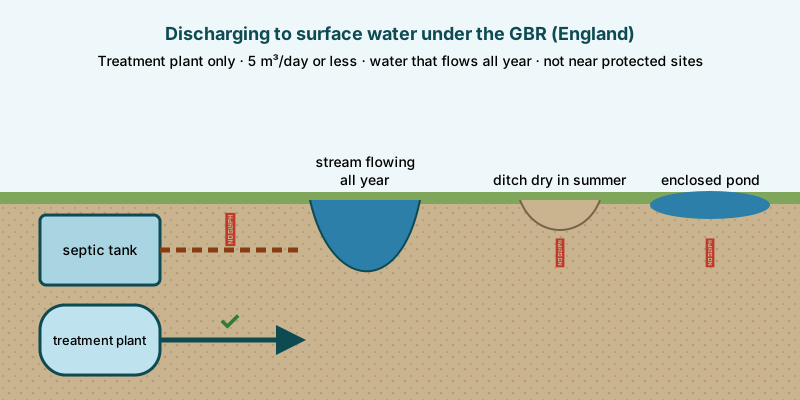
Lots of older country homes have a septic tank with a pipe running to the nearest ditch, brook or river. For decades nobody minded. Now it’s against the rules, and fixing it is often the biggest bill an off-mains homeowner will face.
Quick answer
- Allowed?
- No, not from a septic tank, in England or Wales
- Your options
- Connect to sewer, install a treatment plant, or add a drainage field
- Deadline
- Was 1 January 2020. Now: act as soon as possible
- Plant to a ditch?
- Only if it flows all year and other rules are met
- Typical fix cost
- See our cost guides; plants and fields run into thousands
Rules here are for England unless stated. Check yours with a competent engineer.
Why a septic tank can’t go to a watercourse
A septic tank isn’t a treatment system in any real sense. Solids sink, scum floats, and the liquid in the middle flows out. That liquid is still sewage, full of bacteria and nutrients.
In a drainage field, the soil does the real treatment. Pipe it straight into a stream and nothing does.
So the general binding rules in England say a septic tank must not discharge directly to surface water. Only a small sewage treatment plant can, and only within limits.
What counts as surface water?
More than you might think. Gov.uk lists rivers, streams, estuaries, lakes, canals and coastal waters. A field ditch carrying water to any of these counts too.
The rules also exclude some places entirely, even for a treatment plant:
- a ditch that doesn’t have flowing water all year
- a watercourse that dries up for part of the year
- an enclosed lake or pond
The 2020 deadline, and where it stands now
The original guidance gave owners until 1 January 2020 to deal with septic tanks discharging to surface water. The guidance was later reworded. It now says you must act “as soon as possible”. If you’re fitting a replacement system, plans should be in place within a reasonable timescale, “usually 12 months”.
The deadline passed long ago. Today the question isn’t “when?”. It’s “have you done it?”.
Your three options
1. Connect to the public sewer
If a sewer runs nearby, this is often cheapest over time and ends the problem for good. Contact your local water company. In some cases the Environment Agency expects you to connect if it is “reasonable” to do so.
2. Replace the tank with a treatment plant
A sewage treatment plant cleans the liquid well enough to discharge to a watercourse, provided that it flows all year and you meet the other rules. This is the usual fix where a drainage field won’t work, for example on clay or a small plot.
3. Keep the tank, add a drainage field
If your soil drains well and you have room, a new drainage field can take the tank’s outflow instead of the ditch. A percolation test tells you if the ground is suitable.
There’s one middle route. Gov.uk allows a partial drainage field next to a watercourse, but only after a treatment plant, and extending no more than 10 metres from the water.
Need a price for your property? Our quote service is coming soon. Until then, use the local firms directory and ask at least three for a written quote.
Get quotesConversion units and reed beds
Some firms sell kits that turn a septic tank into a treatment plant, or reed beds that polish the effluent. Gov.uk says these are acceptable only if the result meets the relevant British Standard for treatment plants (BS EN 12566). Get the proof in writing before you buy.
Extra rules for treatment plants discharging to water
Even a plant has to stay clear of sensitive places. For discharges to surface water the guidance sets these buffers:
| Distance | From |
|---|---|
| 500 metres | SSSI, SAC, SPA, Ramsar sites, bathing waters, shellfish waters, freshwater pearl mussel populations |
| 200 metres | An aquatic local nature reserve |
| 50 metres | A chalk river or aquatic local wildlife site |
In tidal waters, the outlet must be below the mean low water spring mark. The daily limit is 5 m³.
Scotland and Wales
Wales. NRW’s free registration says the same thing: if you discharge to surface water, you must use a package treatment plant, and the watercourse must normally hold water all year. Systems working before 6 April 2010 that met the standards of the time get more lenient treatment on location, but still only for package plants.
Scotland. SEPA runs its own registration and permit system under the Environmental Authorisations (Scotland) Regulations 2018. Its online service checks your system type and discharge point when you register. The fee for a small sewage discharge is £198.55. If your existing discharge is untreated, SEPA asks you to email its Water Permitting Team.
Not sure where your pipe goes?
You’re not alone. Many owners have never seen their outlet. A drainage engineer can trace it with a dye test or a CCTV survey. If you’re buying, ask for a septic tank survey before exchange.
The bottom line
A septic tank piping into a ditch is a known, fixable problem. Get it traced, get three written quotes, and get it done. If you’re selling, it’s far easier to sort it, or price it in, than to argue about it late in the sale.
FAQ: septic tanks and watercourses
Can a septic tank discharge into a ditch?
Not in England. Under the general binding rules a septic tank must discharge to a drainage field. A ditch counts as surface water, and only a small sewage treatment plant can discharge to surface water, and only if the ditch flows all year.
What if my ditch is dry in summer?
Then even a treatment plant cannot discharge to it under the general binding rules. The rules exclude ditches without flowing water all year and watercourses that seasonally dry up. You will need a drainage field or a permit.
Can I fit a conversion unit to my septic tank instead of replacing it?
Only if the converted system meets the relevant British Standard for treatment plants. Gov.uk guidance says conversion units and reed beds are acceptable only if they meet the standard. Ask the supplier for proof.
Is it the buyer's or the seller's job to fix it?
The law does not fix that; it is negotiated. The operator is whoever owns the system at the time, so once you buy, the duty is yours. Most buyers use survey results to negotiate a price reduction or ask the seller to do the work first.
Will I be fined?
The Environment Agency can take enforcement action where a discharge pollutes or breaches the rules. The best protection is to have a plan, get quotes and act promptly, keeping records of what you have done.
Sources
All links checked October 2026.
- GOV.UK: General binding rules, small sewage discharge to a surface water
- GOV.UK: General binding rules, small sewage discharge to the ground
- GOV.UK: Septic tanks and treatment plants, permits and general binding rules
- Natural Resources Wales: Register your septic tank or small sewage treatment plant
- SEPA: Septic tanks and private sewage treatment systems
- Checkatrade: Sewage treatment plant installation cost
- Checkatrade: Drainage field cost

We write plain-English guides for UK homes that are not on mains sewers. Every rule links to the regulator. Every price links to where we found it. About us · How we check costs.