
- Home
- Care & problems
- How often to empty
How often should you empty a septic tank?
Short answer: once a year. The longer answer depends on your tank, your household and what the maker's manual says. Here's what the rules say.
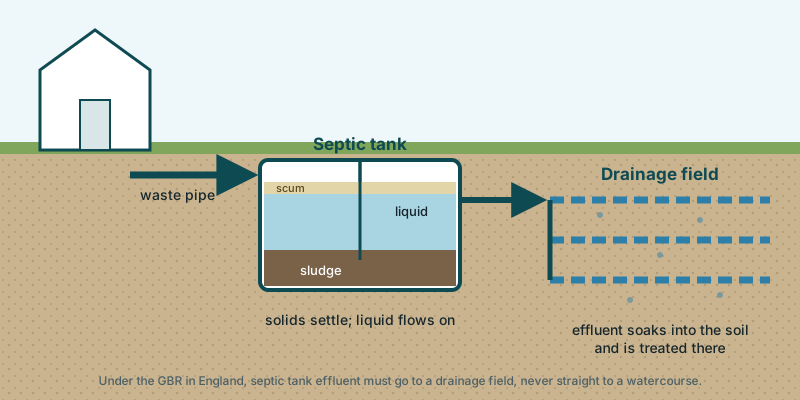
Once a year. That’s the default in England’s general binding rules, in Approved Document H and in SEPA’s advice for Scotland. But the rule has a get-out, and it cuts both ways: follow the manufacturer’s instructions.
Quick answer
- England (GBR)
- At least once a year, or as the manufacturer says
- Building Regs (ADH)
- At least once every 12 months
- Scotland (SEPA)
- De-sludge annually
- Monthly check
- Look at the outlet: effluent should flow freely and clearly
- Cesspit?
- Different: emptied regularly, often monthly
Rules checked October 2026 against gov.uk, Approved Document H and SEPA.
What the rules actually say
England, general binding rules. You must get the sludge removed “before it goes beyond the maximum capacity”. You should do this “at least once a year or in line with the manufacturer’s instructions”. The same wording applies to treatment plants.
Approved Document H (Building Regulations). Its model wording for owners says a septic tank “requires emptying at least once every 12 months by a licensed contractor”. Appendix A repeats it: “at least once a year”.
Scotland, SEPA. The maintenance advice is short: “De-sludge annually”.
So a yearly booking keeps you inside every set of guidance. If your tank’s manual says more often, follow the manual.
When to book sooner
The interval is a minimum, not a target. Book early if:
- more people now live in the house than the tank was sized for
- you’ve had guests or a holiday let running at capacity
- the tank is undersized. Approved Document H says new tanks should hold at least 2,700 litres for up to 4 users, plus 180 litres for each extra user
- you see any warning sign: slow drains, smells, gurgling or wet ground
Leaving it too long is the expensive mistake. If solids carry over, Approved Document H says they can block the pores in the soil. That can mean replacing the drainage field early, and occasionally makes the site unusable for a new one.
Don’t empty it completely
Approved Document H recommends that not all sludge is removed, because it acts as an “anaerobic seed” that gets the tank working again. Mention it when you book. A good contractor will know.
The monthly five-minute check
Approved Document H says septic tanks should be inspected monthly. Lift the outlet chamber lid or distribution box (don’t climb in) and look:
- Outlet: effluent should be free-flowing and clear.
- Inlet: flow should be free-flowing too.
- Drainage field: check it monthly for waterlogging, and that effluent isn’t backing up towards the tank.
Never climb into a tank or chamber. Sewage systems can hold hazardous gases.
Treatment plants
Same default: at least once a year or as the manufacturer says. Plants have moving parts, so they also need regular servicing. The general binding rules say anyone who maintains your system must be competent, such as engineers on British Water’s accredited list.
Need a price for your property? Our quote service is coming soon. Until then, use the local firms directory and ask at least three for a written quote.
Get quotesCesspits are a different story
A cesspit stores everything. Gov.uk says it must be emptied regularly, and gives once a month as an example. See our cesspit emptying cost guide.
Use a registered carrier and keep the paperwork
The firm that takes your sludge must be a registered waste carrier. Ask them, ask the driver for their certificate, or check the Environment Agency register. Keep every receipt. You’ll need maintenance records if you ever sell the house.
FAQ: emptying intervals
How often does a septic tank need emptying in the UK?
In England the general binding rules say at least once a year, or in line with the manufacturer's instructions. Approved Document H says at least once every 12 months, and SEPA says de-sludge annually in Scotland.
Can I leave my septic tank for two years?
Only if the manufacturer's instructions say so. In England you must desludge before the sludge goes beyond the tank's maximum capacity, and the default guidance is at least once a year.
Should a septic tank be emptied completely?
Not necessarily. Approved Document H recommends that not all sludge is removed, because it can act as an anaerobic seed. Ask your contractor.
Do treatment plants need emptying as often as septic tanks?
The general binding rules apply the same default to both: at least once a year or as the manufacturer instructs. Plants also need regular servicing of pumps and blowers.
What happens if I don't empty my septic tank?
Solids are likely to be carried into the drainage field or soakaway. That can block the soil, cause pollution and lead to expensive repairs or early replacement of the drainage field.
Sources
All links checked October 2026.
- GOV.UK: General binding rules, small sewage discharge to the ground
- GOV.UK: General binding rules, small sewage discharge to a surface water
- GOV.UK: Approved Document H, drainage and waste disposal
- SEPA: Septic tanks and private sewage treatment systems
- GOV.UK: If you have a cesspool
- Environment Agency: Public register of waste carriers

We write plain-English guides for UK homes that are not on mains sewers. Every rule links to the regulator. Every price links to where we found it. About us · How we check costs.