
- Home
- Systems explained
- Septic tank vs plant vs cesspit
Septic tank vs treatment plant vs cesspit: what's the difference?
Three systems, three very different sets of rules and running costs. Here's how to tell them apart, and which one suits your property.
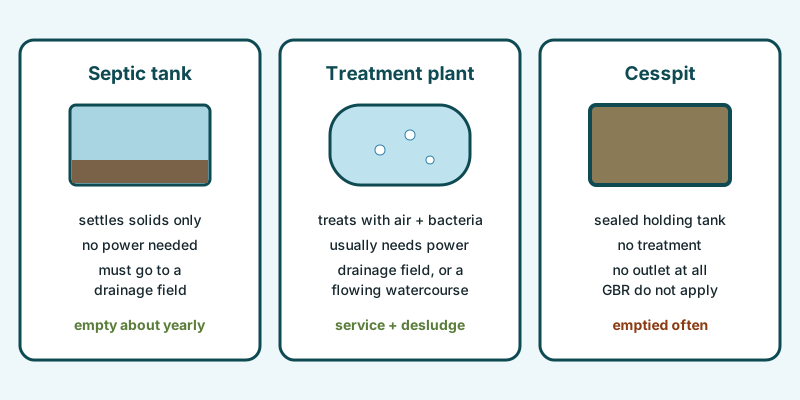
Off mains, your sewage goes into one of three things: a septic tank, a sewage treatment plant or a cesspit. They look alike from above, just a lid or two in the lawn. Underneath they work very differently, and the law treats them differently too.
Quick answer
- Septic tank
- Settles solids; liquid must soak into a drainage field
- Treatment plant
- Treats with air and bacteria; can discharge to ground or a flowing watercourse
- Cesspit
- Sealed tank, no outlet; emptied often
- Cheapest to run
- Usually a septic tank with a healthy drainage field
- Can't drain the ground?
- Treatment plant to a watercourse, or a cesspit as a last resort
Costs and rules below are for England unless stated.
At a glance
| Septic tank | Treatment plant | Cesspit | |
|---|---|---|---|
| What it does | Settles solids | Treats sewage biologically | Stores everything |
| Outlet | Drainage field only | Drainage field or flowing watercourse | None |
| Power needed | No | Usually | No (alarm optional) |
| Emptying | About once a year | Per maker, often yearly | Often; gov.uk’s example is monthly |
| General binding rules apply? | Yes | Yes | No |
| Install cost (typical) | £4,200–£6,000 + VAT | £9,000–£13,000 | Get quotes |
Costs are from the sources below, checked October 2026. Your job may differ.
Septic tank: simple and cheap to run
A septic tank is a two-chamber tank. Sewage flows in, solids sink to form sludge, fats float as scum, and the clarified liquid flows out to a drainage field. There, bacteria in the soil finish the job.
Good for: properties with free-draining soil and room for a drainage field.
Watch out for: it can’t discharge to a ditch or stream in England, ever. And the drainage field is the weak point. Once it’s clogged, it’s an expensive dig.
Sewage treatment plant: cleaner, but needs power
A treatment plant goes further. After the solids settle, a blower or pump pushes air through the liquid, so bacteria can break it down. A final chamber lets the remaining solids settle out. What leaves is much cleaner.
Good for: heavy clay, small plots, high water tables, or anywhere you need to discharge to a stream.
Watch out for: electricity and moving parts. Approved Document H says a plant that needs power should keep working for up to 6 hours without it, or have an uninterruptible supply. Most need an annual service as well as emptying.
Cesspit: storage only
A cesspit, or cesspool, is a sealed tank. Nothing treats the sewage and nothing leaves it except via a tanker. That makes it simple, but it fills fast. New ones must hold at least 18,000 litres for two users, plus 6,800 litres for each extra user.
Good for: sites where nothing else is possible.
Watch out for: emptying bills. They add up quickly.
Need a price for your property? Our quote service is coming soon. Until then, use the local firms directory and ask at least three for a written quote.
Get quotesWhich do you have?
Five quick clues:
- An electric cable, blower or alarm box? Almost certainly a treatment plant.
- A tanker every few weeks? Probably a cesspit.
- Once a year, and a soggy patch somewhere downhill? A septic tank with a drainage field.
- Paperwork. The seller’s property information form asks this, and so should your survey.
- Ask. A local emptying firm will usually know at a glance.
How the law treats each one
- Septic tanks and treatment plants fall under the general binding rules in England. Meet them and you need no permit.
- Cesspits are outside those rules. You still must keep them emptied by a registered waste carrier and stop them leaking or overflowing. The council or the Environment Agency can make you repair or replace one in poor condition.
- Scotland and Wales require registration of septic tanks and plants: SEPA charges £198.55, and registration with NRW is free.
Which should you choose?
If you’re building or replacing, the order is roughly:
- Mains sewer, if it’s within reach. For new discharges, it’s expected where reasonable.
- Septic tank or plant with a drainage field, if the soil passes a percolation test.
- Treatment plant to a flowing watercourse, if the ground won’t drain.
- Cesspit, as a last resort.
Approved Document H says non-mains systems should only be considered where connecting to mains drainage isn’t practicable. It adds that treatment plants suit tight spaces, or sites where other options won’t work. Either way, get a percolation test and a designer who knows Building Regulations before you buy anything.
FAQ: choosing a system
What is the difference between a septic tank and a sewage treatment plant?
A septic tank only lets solids settle, so its outflow must be treated by the soil in a drainage field. A treatment plant pumps air through the sewage so bacteria break it down, producing a much cleaner effluent that can go to a drainage field or, under conditions, a flowing watercourse. Most plants need electricity.
What is the difference between a cesspit and a septic tank?
A cesspit (or cesspool) is a sealed holding tank with no outlet at all. Everything that goes in has to be taken away by tanker. A septic tank has an outlet to a drainage field and only needs emptying about once a year.
How do I know what system I have?
Check your property deeds, home survey or the seller's information first. If you have an electric blower or alarm panel, it is probably a treatment plant. If a tanker comes every few weeks, it is probably a cesspit. A drainage engineer can confirm it in one visit.
Is a cesspit legal?
Yes. The general binding rules do not apply to cesspools, but you must have them emptied regularly by a registered waste carrier and they must not leak or overflow. New cesspools need planning permission and Building Regulations approval.
Which system is best for a new build?
New discharges must connect to the public sewer where the Environment Agency considers it reasonable. If not, a treatment plant is the usual choice where a drainage field is not possible, and a septic tank with a drainage field where the ground drains well. Approved Document H says non-mains systems should only be considered where mains connection is not practicable.
Sources
All links checked October 2026.
- GOV.UK: Septic tanks and treatment plants, permits and general binding rules
- GOV.UK: General binding rules, small sewage discharge to the ground
- GOV.UK: Approved Document H, drainage and waste disposal
- Checkatrade: Septic tank installation cost
- Checkatrade: Sewage treatment plant installation cost
- Call2Drain: Cesspit emptying cost UK 2026
- Checkatrade: Septic tank emptying cost

We write plain-English guides for UK homes that are not on mains sewers. Every rule links to the regulator. Every price links to where we found it. About us · How we check costs.